As the era of sixth-generation (6G) mobile communications approaches, scientists are envisioning a paradigm shift: moving beyond networks reliant on single satellites toward a future where multiple satellites collaborate in orbit to deliver faster, more stable, and more intelligent services.
Recently, a team led by Assistant Professor Bodong Shang at the Eastern Institute of Technology, Ningbo (EIT) published a paper in the prestigious IEEE Communications Surveys & Tutorials (Impact Factor: 46.7). The paper, titled Multi-Satellite Cooperative Communications for 6G: Fundamentals, System Design, and Applications, explores this very concept.
The research team has proposed six cutting-edge research directions, with Multi-Satellite Cooperative communications and Integrated Sensing and Communications standing out as particularly exciting. This points to a future where satellites do more than just transmit data; they will process information like space computers and even possess sensing capabilities, enabling the convergence of communication, sensing, computation, and intelligence.
Why Form Satellite Clusters?
As demands for higher network speed, lower latency, and broader coverage intensify, single satellites struggle to bear the burden alone. This is especially true in remote areas, oceans, and airspace where terrestrial networks are unavailable—the demand for satellite communication is growing, but the capability of an individual satellite remains inherently limited. Multi-satellite cooperation functions like a well-coordinated team: some satellites handle access, others act as relays, and some manage resource scheduling. By each playing their part, users can enjoy high-quality network services no matter where they are.
How Do Satellites Cooperate?
The research team has summarized three primary collaborative architectures:
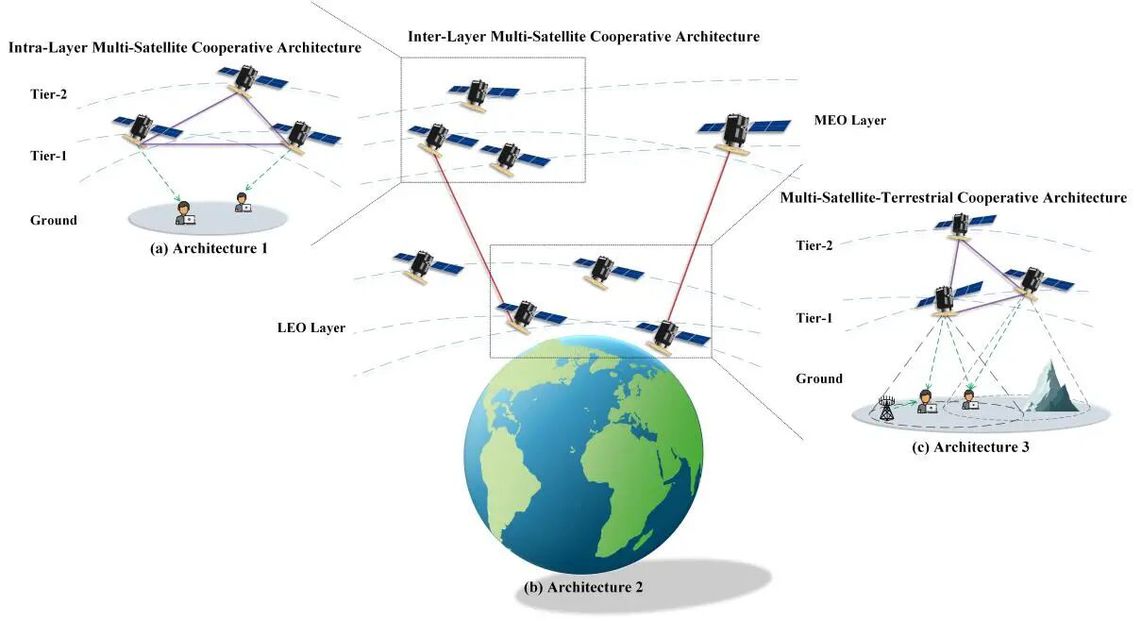
Three Exemplary Architectures for Multi-Satellite Cooperative Communication. Image provided by the research group
Intra-layer multi-satellite cooperative architectures: satellites within the same orbital altitude are interconnected via Optical inter-satellite links (OISL), forming a satellite cluster to provide users with low-latency services.
Inter-layer multi-satellite cooperative architectures: satellites at different orbital altitudes (e.g., Low Earth Orbit and Medium Earth Orbit) divide their work. Low Earth Orbit satellites are responsible for user access, while Medium Earth Orbit satellites handle data relay.
Cross-layer multi-satellite-terrestrial cooperative architecture: Satellites work in coordination with ground base stations. Users can connect simultaneously to both satellite and terrestrial networks, enhancing connection reliability.
Five Operational Modes for Smarter Collaboration
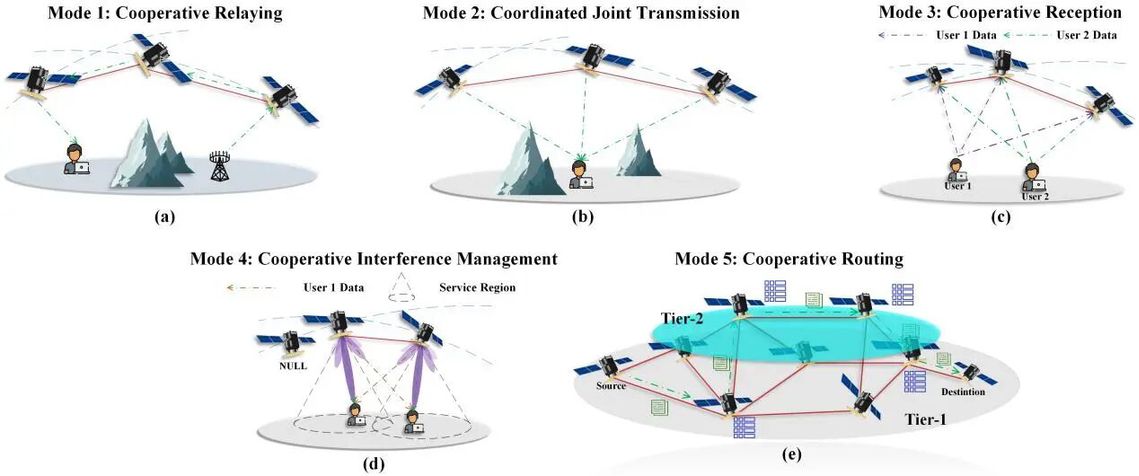
Five Operation Modes for Multi-Satellite Cooperative Networks. Image provided by the research group
The study also identifies five operational modes for satellite cooperation, akin to designing different tactics for the satellite team:
Cooperative relaying mode: satellites forward signals among themselves to expand coverage area.
Coordinated joint transmission mode: it enhances transmission efficiency by enabling multiple satellites to jointly serve users.
Cooperative reception and beamforming mode: signals from multiple satellites are superimposed to enhance signal quality at the user terminal.
Cooperative interference management mode: it mitigates interference by using spatial beam management and multiplexing techniques
OISL-based cooperative routing mode: it reduces latency and increases throughput in the multi-satellite network.
Future Satellites: Not Just Signal Relays but Data Processors
Multi-satellite cooperative communication is not only seen as a core enabling technology for achieving ubiquitous 6G coverage but also provides an efficient and feasible technical framework for next-generation integrated space-air-ground-sea communication applications.
The technical system and theoretical framework proposed in the paper are also applicable to multiple domains, including satellite internet and the convergence of communication and computing, demonstrating its broad cross-scenario application. This research represents a significant advancement in the field of 6G satellite communication and cooperative networks, offering a path towards a unified knowledge base, clear technical classification, and implementable optimization strategies.
In the future, leveraging the technical framework and research pathways established by this research, we can anticipate building more efficient, reliable, and comprehensively covered 6G communication networks—where satellites not only transmit data but also process information like space computers and even possess sensing capabilities, achieving the fusion of communication and perception.
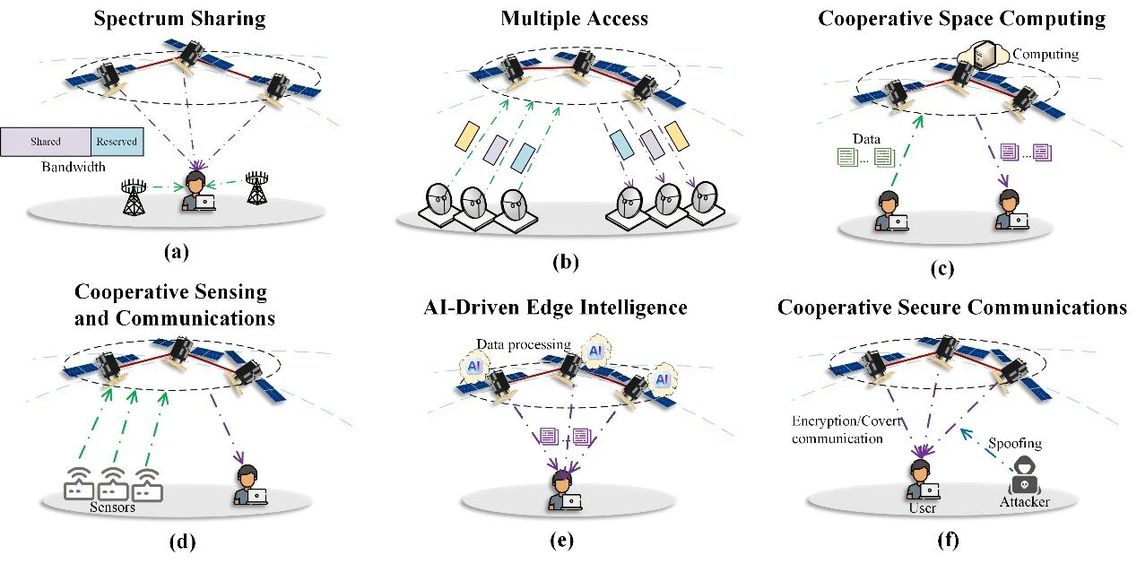
Six Future Research Directions for Multi-Satellite Cooperative Networks. Image provided by the research group
The first affiliation of the paper is the Eastern Institute of Technology, Ningbo. Bodong Shang is the first author. Contributing authors include Xinyi Huang, a joint Ph.D. student trained by EIT and the University of Science and Technology of China; Huayuan Wang, a joint Ph.D. student trained between EIT and The Hong Kong Polytechnic University, and Xiangyu Li, a joint Ph.D. student trained between EIT and Shanghai Jiao Tong University. The corresponding author is Professor Meixia Tao from Shanghai Jiao Tong University. Other collaborators include Professor Haijun Zhang from the University of Science and Technology Beijing and Professor Pingzhi Fan from Southwest Jiaotong University.